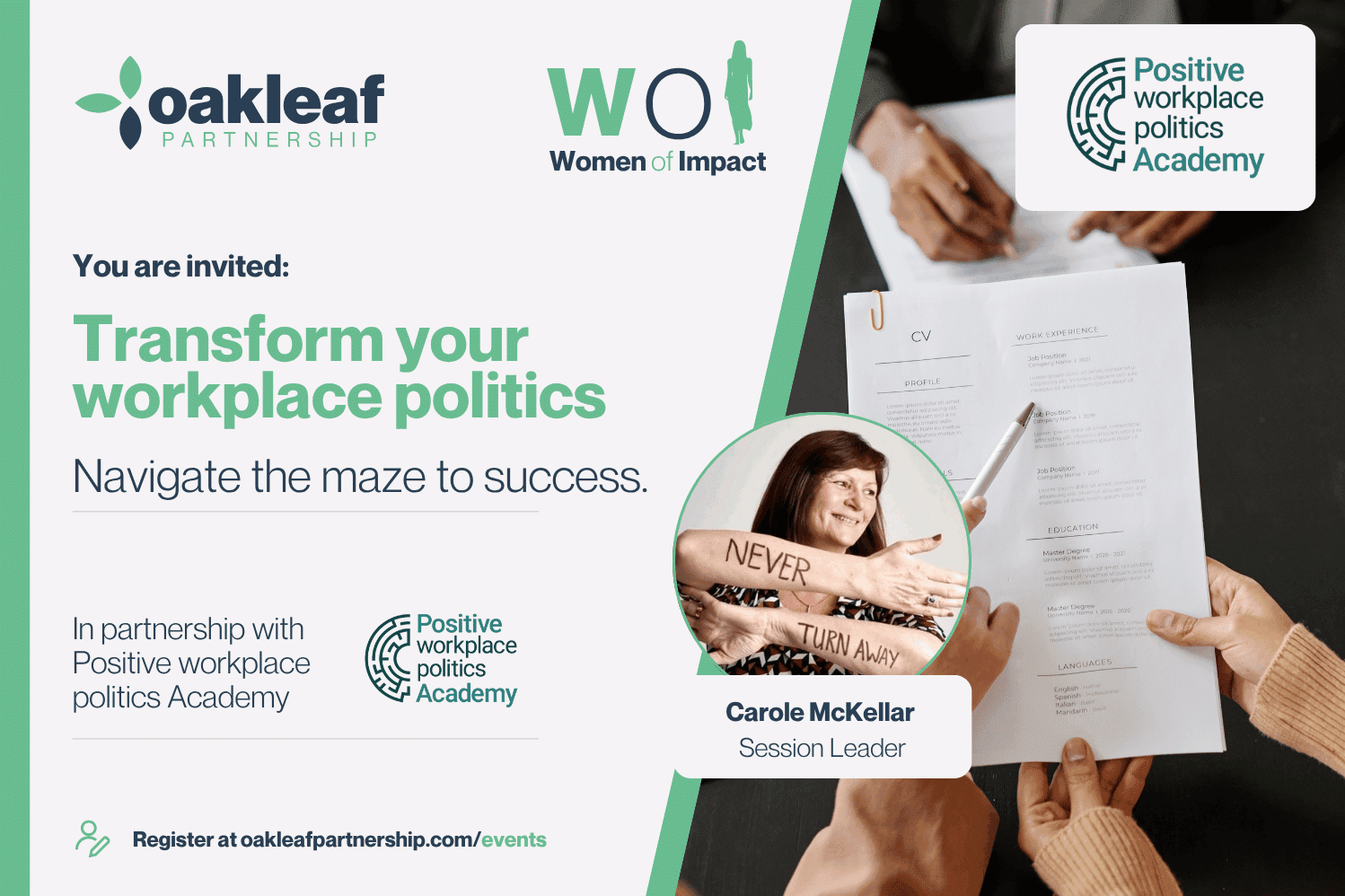
Workplace politics is often spoken about with a hint of discomfort, seen as something to avoid rather than understand. Yet, when harnessed positively, it becomes one of the most powerful enablers of collaboration, progress and leadership effectiveness. Oakleaf Partnership recently hosted a session with Carole McKellar from the Positive Workplace Politics Academy, exploring how shifting perceptions of politics can transform the way organisations work.
Rethinking Workplace Politics
Carole has long championed the idea that politics is not inherently negative. It is, in fact, how organisations operate. Decisions are influenced through people, relationships and trust, and those who can navigate these dynamics with awareness and integrity are often the ones who create lasting impact. Her work reframes politics as a skill that, when understood, accelerates alignment, speeds up decision-making and drives effective teamwork.
She encourages leaders to start by asking a simple question: What atmosphere are you working within? Understanding this context reveals how perceptions shape behaviours. Many professionals, particularly women, have historically opted out of political environments, believing that hard work alone should be enough to achieve success. Research from Roffey Park and Warwick Business School, shared during the session, reinforces how this avoidance can limit both individual and organisational growth. Embracing politics as a tool for influence allows leaders to build stronger, more resilient teams.
The Role of Perception
As David Bancroft Turner explains, “Politics is not what I do, it’s why you think I am doing it.” The statement highlights how perception defines reality in the workplace. What one person sees as strategic influence, another may interpret as self-interest. Awareness of this difference is key. Political competence requires understanding our own beliefs, how they shape our behaviour and how others interpret our intent.
Carole shared a simple but striking illustration of perception bias using a short basketball video where viewers often miss a key detail because their attention is fixed elsewhere. The message was clear — what we see is influenced by what we expect to see. Leaders who recognise this are better equipped to read situations objectively, build trust and foster clarity in communication.
Building Political Competence
Building political competence is not about manipulation, it is about authenticity and intention. It requires aligning personal goals with organisational purpose, knowing when to challenge and when to listen, and developing the confidence to operate with both empathy and conviction. Carole advocates a practical framework — Reveal, Ask, Rapport — that helps leaders communicate purpose, make clear requests and strengthen relationships through openness.
Leading with Influence and Awareness
As organisations continue to evolve, so too must our understanding of how things truly get done. Politics exists wherever people interact, and ignoring it means missing an opportunity to lead with influence and awareness. Positive workplace politics can unblock barriers, enable change and create the conditions for meaningful collaboration.
Carole concludes that we cannot ignore workplace politics and hope to achieve personal and organisational goals. Business and technical skills are critical to success and so are the political skills to navigate the maze of workplace politics to get things done. Unfortunately, this competency is rarely specifically covered in personal development or management training programmes. Find out more at pwp.academy and try out one of the new self- assessments. Incorporating this competence into your development activities will have an impact on retention, performance and mental health within your organisation.