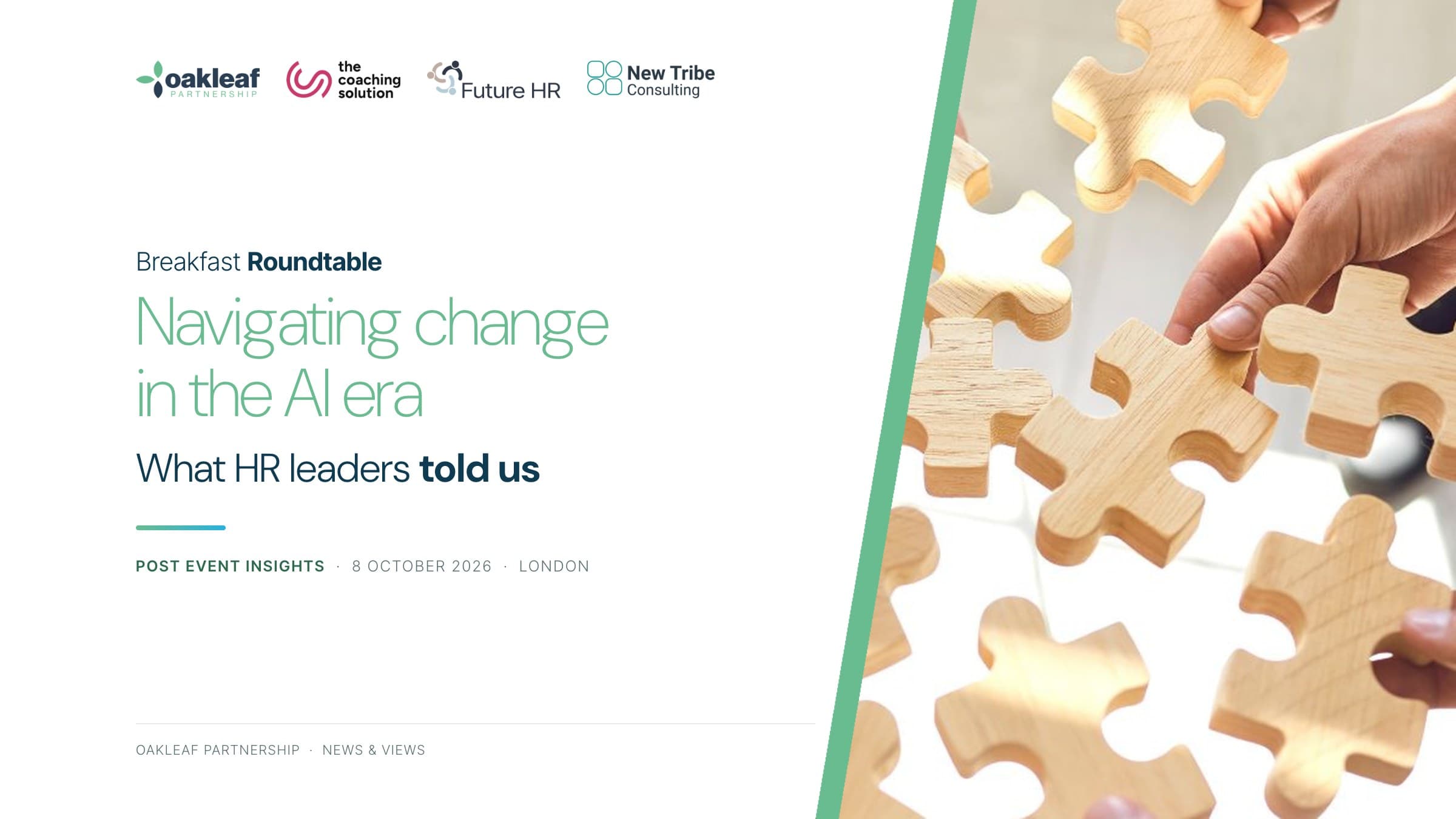

Earlier this month, Oakleaf Partnership and The Coaching Solution brought together a group of HR leaders to discuss navigating change in the AI era, expertly facilitated by Martin Tynan of New Tribe Consulting and Liz Jewitt-Cross of Future HR.


What followed was a refreshingly honest conversation about the gap between AI adoption and AI value.
On the surface, AI appears to be everywhere. The pace of technological advancement continues to accelerate, and most organisations are no longer debating whether to adopt AI. The question has shifted to how they move beyond experimentation and deliver meaningful business outcomes.
The challenge is that adoption and impact are proving to be very different things.
McKinsey's latest global research found that 88% of organisations are now using AI in at least one business function, up from 78% the previous year. Yet nearly two thirds have not begun scaling AI across the enterprise, and only 39% report a measurable EBIT impact from their AI investments.
This disconnect between activity and value was a recurring theme throughout the discussion. Many organisations have no shortage of pilots, proofs of concept and experimentation. What remains less clear is how those initiatives connect to strategic objectives, and ultimately create measurable business value.
Leadership alignment: the missing link
One of the strongest themes to emerge from the discussion was the importance of leadership alignment.
Different members of the Executive Committee often approach AI through entirely different lenses. For some, AI is primarily a productivity play. For others, it represents cost reduction, growth, innovation, customer experience, risk management or governance.
None of these perspectives are wrong. The challenge arises when they exist in isolation.
Without a shared understanding of the outcomes AI is intended to deliver, organisations can quickly find themselves pursuing multiple disconnected initiatives. Teams launch pilots to solve local problems, functions adopt different tools, and investment decisions become fragmented. The result is often significant activity but limited impact across the enterprise.
McKinsey's research suggests that organisations generating the greatest returns from AI are not focused solely on efficiency. They combine productivity gains with revenue growth, innovation and customer value creation. In other words, AI delivers the most impact when it is embedded within a broader business strategy, rather than treated as a standalone technology programme.
The discussion highlighted an important shift in mindset for leaders.
The human side of AI adoption
While technology continues to evolve rapidly, the barriers to adoption discussed around the table were overwhelmingly human.
Common challenges included:
Interestingly, very few of these barriers relate directly to the technology itself.
Instead, they reflect familiar change management challenges that HR leaders have been navigating for decades. The tools may be new, but many of the obstacles are not.
Several leaders shared experiences of employees feeling overwhelmed by the pace of change. In many organisations, AI is arriving alongside wider business transformation, restructures, skills shortages and evolving workforce expectations. Against that backdrop, asking people to embrace yet another change initiative requires careful thought and planning.
As one participant observed, organisations often underestimate the emotional dimension of technology adoption. Employees are not simply learning new tools; they are trying to understand what those tools mean for their role, their future and their value to the organisation.
Are organisations investing in the right areas?
This led naturally to a discussion about investment priorities.
Deloitte reports that 78% of organisations plan to increase AI investment. However, 93% of that investment is focused on technology itself, while only 7% is directed towards people and capability building.
At the same time, more than two thirds of organisations expect 30% or fewer of their AI experiments to reach scale in the next six months.
The contradiction is difficult to ignore.
Many organisations recognise that people are critical to AI success, yet investment remains disproportionately weighted towards platforms, tools and infrastructure. While these investments are clearly necessary, the discussion raised a broader question: are organisations dedicating sufficient resources to helping people adapt to new ways of working?
Organisations that successfully scale AI are likely to be those that invest not only in technology, but also in upskilling, leadership capability, communication and organisational readiness.
Why language matters more than we think
One of the most interesting discussions focused on the language organisations use when talking about AI.
Words that seem straightforward to leaders can be interpreted very differently by employees.
Terms such as efficiency automation productivity and AI first are often intended to signal progress and opportunity. Yet for many employees, the same language can trigger concerns about job security, workloads or relevance.
This aligns with broader thinking on organisational change and communication. Employees do not respond solely to what leaders say; they respond to what they believe those messages mean for them personally.
The group discussed how easily organisations can create resistance unintentionally. A strategy designed to empower employees can be heard as a strategy to replace them. A transformation initiative intended to improve customer outcomes can be interpreted as another cost cutting exercise.
This is why communication cannot be an afterthought.
Leaders need to move beyond talking about the technology itself and spend more time explaining the problem being solved, the outcomes being sought and the role people will play in making change successful.
The role of HR
For HR leaders, the opportunity is significant.
Historically, major transformations have often been led by technology or operational functions, with HR supporting implementation. AI presents a different challenge. While the technology is central, the success or failure of adoption will depend heavily on human behaviour, leadership alignment, organisational culture and workforce capability.
In many ways, this places HR at the heart of the conversation.
The organisations that unlock the greatest value from AI are unlikely to be those with the most tools. They will be those that create the conditions for adoption:
Final reflections
The most important takeaway from the roundtable was surprisingly simple.
As AI continues to reshape the way organisations operate, leaders who focus exclusively on technology may find themselves disappointed by the results. Those who focus equally on people, culture and business outcomes will be far better positioned to realise its potential.
Thank you to everyone who attended, to our facilitators Martin Tynan and Liz Jewitt-Cross of Future HR, and to Selina Van Laere at The Coaching Solution, for such valuable perspectives.