Insights · HR Leadership
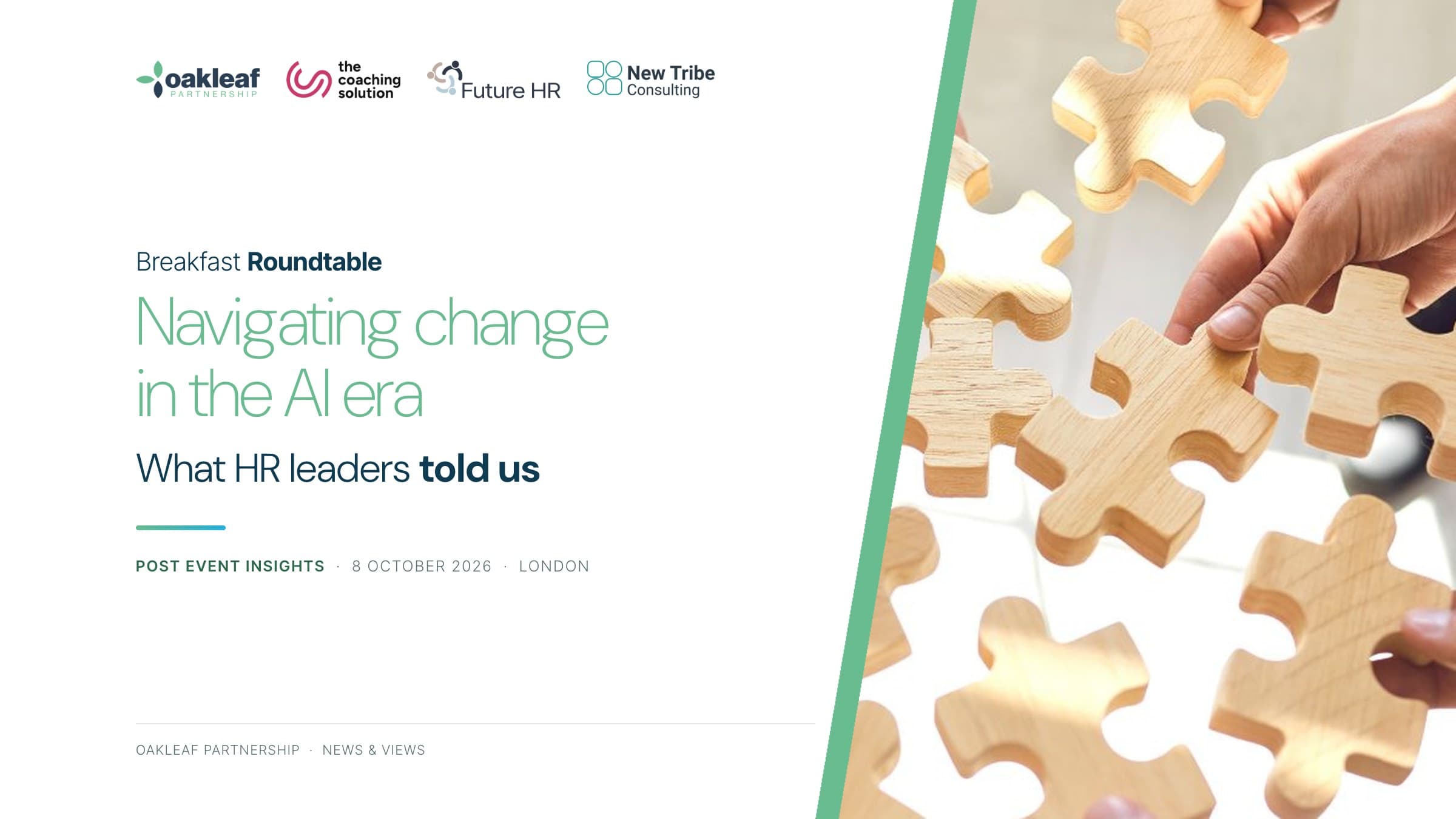
Oakleaf Partnership and The Coaching Solution recently brought senior HR leaders together at The Ivy, Liverpool Street to explore a major shift facing organisations today: the evolution of the Chief People Officer from functional specialist to enterprise leader.
Hosted in partnership with The Coaching Solution, the event also marked the launch of a new collaboration between the two organisations. By combining HR talent expertise with executive coaching, mentoring, leadership development and assessment, the partnership is designed to help businesses respond to increasingly complex people and organisational challenges.
The discussion was led by Liz Jewitt-Cross FCIPD (Managing Director, Future HR), Perry Timms (Founder and Chief Energy Officer, PTHR), and Selina Van Laere (The Coaching Solution), and focused on how the Chief People Officer role is evolving — and why future HR leaders will need to operate well beyond the traditional boundaries of the function.
From HR leader to enterprise leader
Liz opened the session by setting out the scale of the challenge facing organisations. Leaders today are expected to deliver growth, drive transformation, improve productivity, manage costs, adopt AI, respond to changing workforce expectations and maintain customer trust — often all at once, and in a context of constant disruption.
These challenges rarely sit neatly within a single function. Instead, they cut across people, technology, operations, culture and commercial performance. As a result, the most effective Chief People Officers are no longer focused solely on the people agenda. They are increasingly acting as organisational diagnosticians and enterprise leaders, able to connect insights across the business and translate them into strategic action.
This shift demands a broader capability set. Tomorrow’s CPO will need strong commercial awareness, financial literacy and enterprise-wide thinking, alongside the ability to influence at executive level, lead transformation and understand organisational effectiveness, systems thinking and emerging technologies such as AI.
CPOs are moving beyond being the HR expert in the room to becoming true enterprise leaders — helping shape strategy, priorities and execution.
Liz Jewitt-Cross FCIPD, Future HR
This is a significant step change, and it raises an important question: are future HR leaders equipped and preparing to operate at this level? For years, HR has debated its place at the leadership table. Today, the more pressing question may be whether organisations are ready for what the Chief People Officer role is becoming.
The rise of the Enterprise CPO
Perry Timms explored the concept of the Enterprise CPO through the lens of the Polymorphous Organisation — an enterprise designed to intentionally change shape over time. In this model, structure is not fixed but adaptable. Leadership is not defined purely by hierarchy, but by context. Jobs are no longer seen as static roles, but as fluid combinations of skills, capabilities and outcomes.
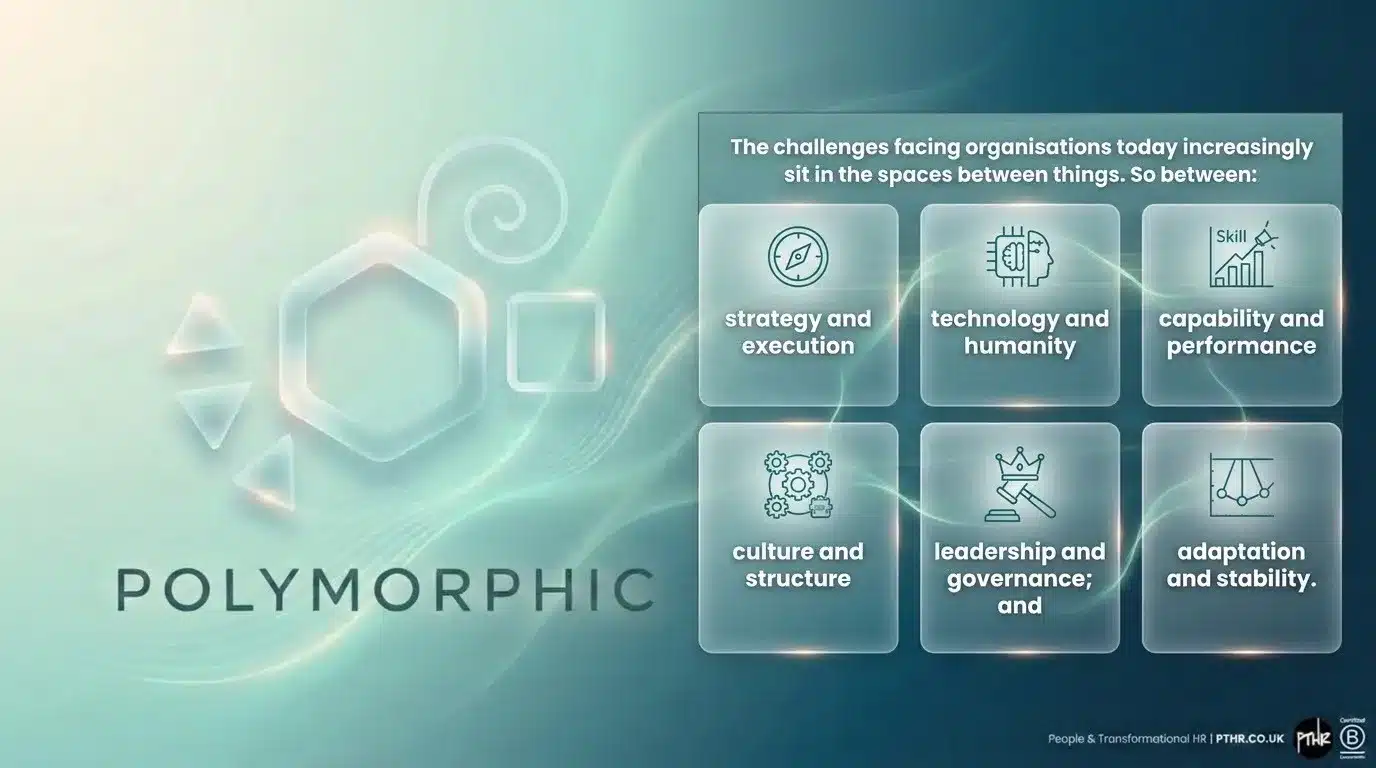
Within this environment, complexity cuts across traditional organisational boundaries. AI is not just a technology issue. It is also a workforce issue, a capability issue, a leadership issue, a redesign issue and ultimately a strategic issue. Culture is shaped not only by stated values, but by operating models, decision rights, incentives, information flows and power structures.
Traditional executives optimise within their own function. Enterprise leaders focus on how the whole system performs and adapts.
Perry Timms, PTHR
In this context, the Enterprise CPO helps the organisation understand how people, work, technology, leadership, culture and performance interact as a single system.
Why coaching and mentoring become strategic infrastructure
Selina Van Laere explored what this shift means for leadership development. As leadership becomes less about hierarchy and more about adaptability, coaching and mentoring are becoming a core part of how organisations build capability.
Leaders are expected to navigate ambiguity, balance competing priorities, influence without formal authority, and adapt both themselves and their organisations. Mentoring complements this by providing access to experience and judgement from those who have operated in similar environments. Transition coaching is especially important for senior hires, helping them understand organisational dynamics quickly and avoid early misalignment.
Coaching creates space to think — to reflect, test assumptions and improve decision making.
Selina Van Laere, The Coaching Solution
A new era for people leadership
The role of the Chief People Officer is entering a new phase. Future CPOs will be judged on their ability to help organisations adapt, learn, perform and evolve. This requires understanding capability flow, identifying performance friction and recognising how systems and incentives shape behaviour. It also means viewing AI as a work design and organisational challenge, not just a technology issue.
As organisations become more complex and fluid, the Chief People Officer is increasingly one of the most important leadership roles in the enterprise.
Key takeaways
- The CPO is becoming an enterprise leader, not solely a people specialist.
- AI is a work-design and organisational challenge — not only a technology one.
- Coaching and mentoring are now strategic infrastructure for building capability.
- Future CPOs will be judged on how well they help organisations adapt and evolve.
Meet the speakers
The discussion was led by three leaders shaping the future of people and organisational strategy.




About The Coaching Solution
The Coaching Solution is an award-winning consultancy providing business-focused development for senior leaders and their teams. They support organisations through coaching, mentoring, communication development and team-based leadership programmes, helping leaders operate effectively in complex environments.
About Oakleaf Partnership
Oakleaf Partnership is a specialist HR executive search and recruitment firm operating globally across all industry sectors. The firm provides bespoke solutions across the full HR spectrum, including Chief People Officer, HR Director, talent, reward, organisational development and transformation roles.
With over 20 years of experience, Oakleaf combines deep market intelligence, an extensive global network and a partnership-led approach to support clients in accessing high-calibre HR talent. Oakleaf is known for its strong relationships within the HR community, its commitment to quality and its ability to deliver tailored search, market mapping and talent solutions that align with each client’s strategic objectives.